
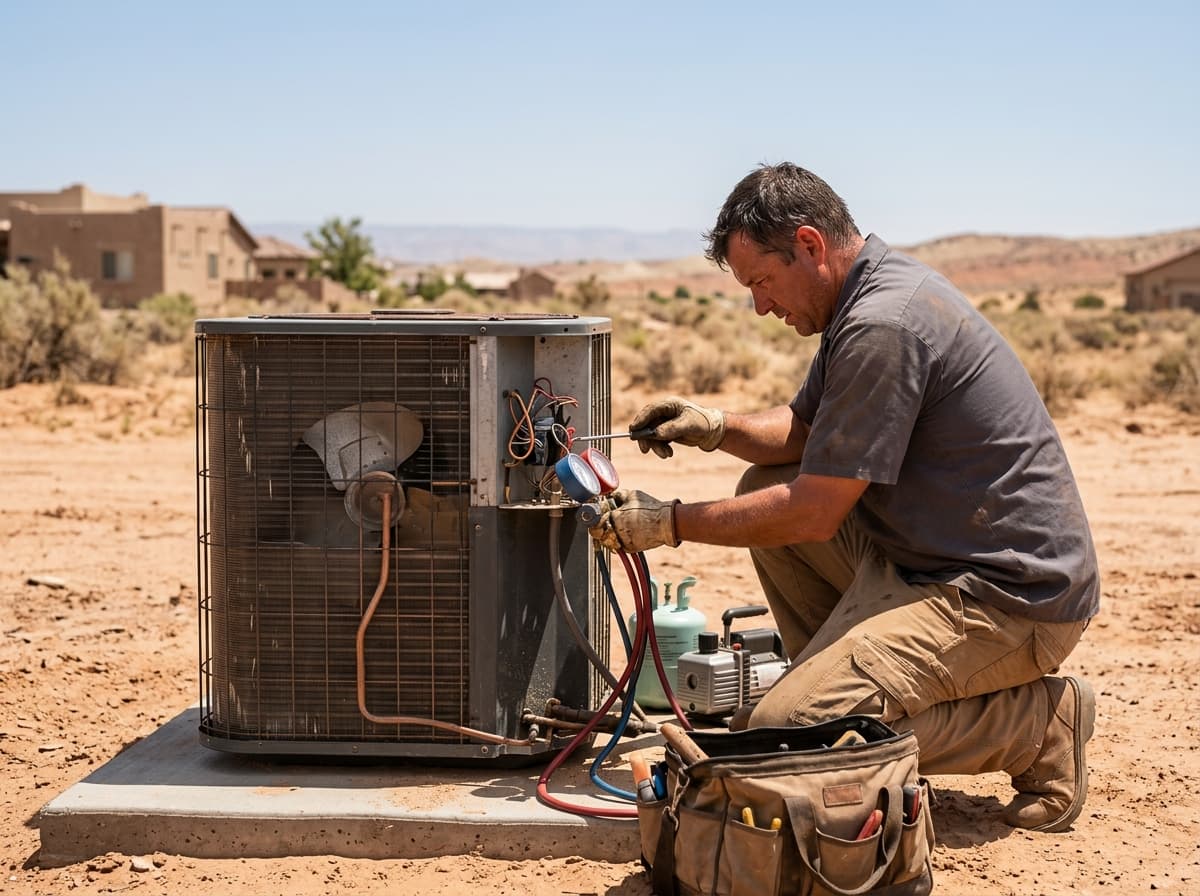
When it's 110 outside and your AC runs nonstop but the house won't cool, something's wrong. Here are the common causes — which you can check yourself, and which need a tech fast.
There's a specific kind of frustration that comes on a 110-degree St. George afternoon: the AC is running and running, you can hear it working, but the thermostat just won't hit its setting. The house creeps warmer no matter what the dial says. When cooling can't keep up in extreme heat, it's usually one of a handful of causes. Here's how to sort out what's going on.
Start With the Simple Stuff
Before anything else, check your filter. In our dusty climate a filter clogs fast, and a clogged filter chokes airflow enough to cripple cooling on a hot day. If it's gray and packed, swap it and give the system an hour to recover — this alone fixes a surprising number of no-cooling calls.
While you're at it, walk out to the condenser unit and look at it. If it's buried in cottonwood fluff, dust, and yard debris, it can't shed heat, and cooling suffers. These are the two things worth checking yourself before you pick up the phone.
Dirty Condenser Coils
Your outdoor unit works by dumping your home's heat into the outside air. When the coils on that unit are caked with the dust and grime that our climate throws at them, they can't release heat efficiently. On a mild day you'd never notice. On a 110-degree day, that lost efficiency is the difference between keeping up and falling behind.
You can gently rinse visible debris off the outside of the unit with a garden hose, but a proper coil cleaning is a job for a tech who can do it without bending the delicate fins or getting into the electrical components.
Low Refrigerant
Refrigerant is what actually moves heat out of your home, and your system is a sealed loop that should never lose it. If it's low, it's because there's a leak somewhere. Signs include ice forming on the lines at the indoor unit, a hissing sound, or cooling that's gotten progressively weaker over a season.
This is not a DIY fix. Refrigerant is regulated, requires certification to handle, and simply topping it off ignores the leak that caused the loss. A tech needs to find the leak, repair it, and recharge the system to the correct level.
A Failing Capacitor
The capacitor is a small component that gives your compressor and fan motors the jolt they need to start and keep running. Heat is hard on capacitors, and a St. George summer is about as hard as it gets. When one starts to fail, you might hear a humming or clicking from the outdoor unit, or the fan struggling to spin up.
A weak capacitor makes the whole system run poorly and can leave you with no cooling entirely if it quits. It's a common, fixable failure — but it's a tech's job, since capacitors hold a charge and the wiring isn't something to guess at.
Leaky Ducts and an Undersized Unit
If your ductwork has gaps or disconnected sections running through a blazing-hot attic, a big share of your cooled air escapes before it ever reaches a room. The system runs full tilt and you still don't feel it. Sealing those ducts often restores comfort you didn't know you'd lost.
The other possibility is that the unit was simply undersized for the home or the climate. An AC that's a touch too small can coast through mild weather but has no reserve for a triple-digit day. A tech can measure whether your system is properly matched to the house.
An Aging System Near the End
Air conditioners in Southern Utah work brutally hard for a long cooling season, and that shortens their lifespan compared to milder climates. If your system is pushing 12 to 15 years, needs repairs more often, and just can't hold a comfortable temperature on hot days anymore, it may be reaching the end of its useful life.
That doesn't always mean replace it today — but it does mean a straight conversation about whether continued repairs are worth it versus putting that money toward a system that can actually handle our summers.
When to Call Marlin
If you've checked the filter and cleared the condenser and your home still won't cool, it's time for a tech. Anything involving refrigerant, capacitors, coils, or ductwork needs professional hands, and our AC repair crew can diagnose the real cause instead of throwing parts at it. When it's dangerously hot and you have no cooling at all, that's an emergency — and our 24/7 emergency AC repair line means you're not waiting until morning.
We offer same-day service across St. George and Southern Utah, and we've kept homes here cool since 1978. When the heat is this serious, don't tough it out — call us.

Marlin Plumbing Heating & Air
Serving St. George, Utah since 1978