
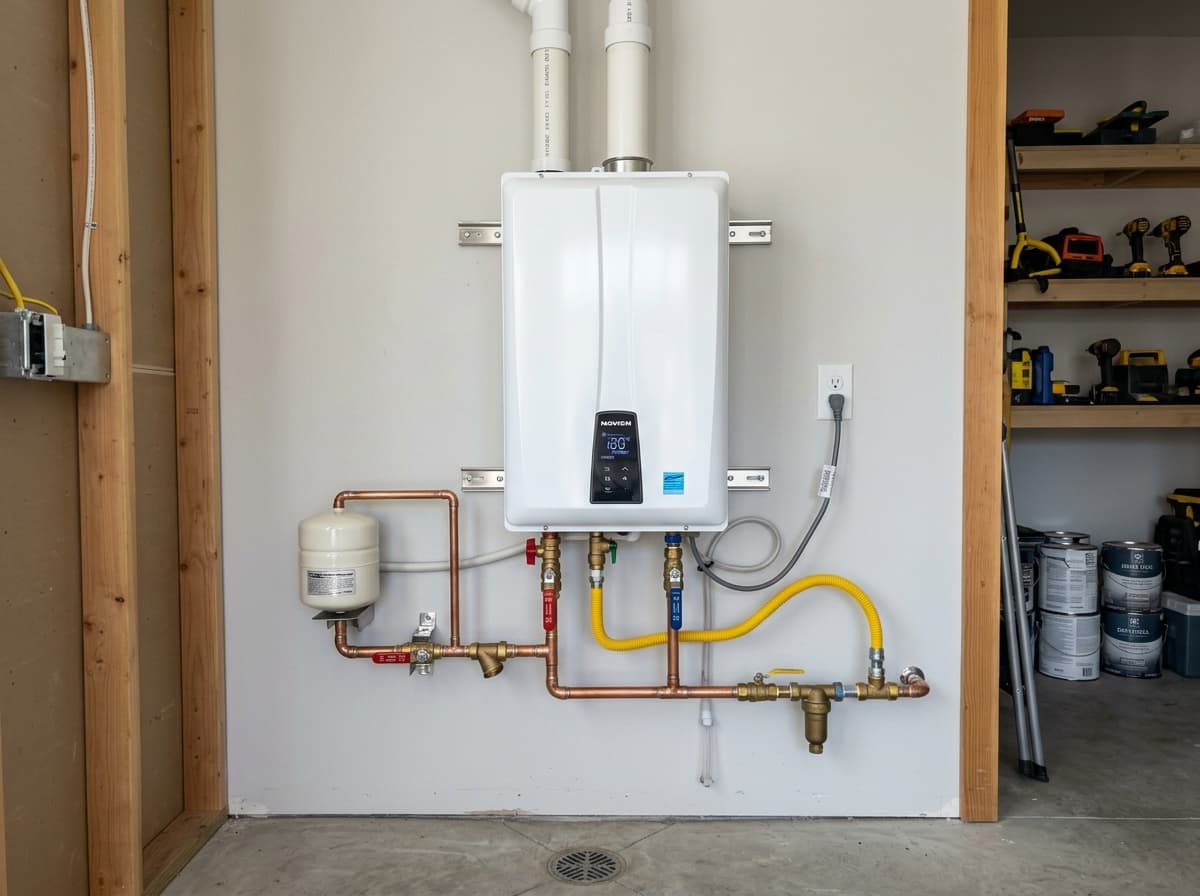
Tankless water heaters promise endless hot water and a long life — but St. George's extreme hard water changes the math. Here's who they're genuinely worth it for and what it takes to protect one.
Tankless water heaters have a lot of fans, and for good reason — endless hot water, a long lifespan, and a small footprint are real advantages. But before you make the switch in St. George, there's a local catch you can't ignore: our water is some of the hardest in the country, and hard water is the one thing that can quietly eat a tankless unit alive. Here's an honest look at the upsides, the catch, and who tankless actually makes sense for in Southern Utah.
The Case for Tankless: Endless Hot Water
A tank water heater holds a fixed amount of hot water. Run it dry with back-to-back showers and a load of laundry, and you're waiting for it to recover. A tankless unit heats water on demand as it flows through, so it never runs out — as long as you size it correctly for the home, you can run hot water as long as you need it.
For a busy household that keeps hitting the bottom of the tank, that endless supply is the feature that sells people on making the switch.
Longer Life and a Smaller Footprint
A well-maintained tankless unit can last 15 to 20 years — often close to double the lifespan of a typical tank. And instead of a bulky cylinder eating up floor space in the garage or a closet, a tankless unit mounts on the wall and frees up the room around it.
For homeowners tight on space, or anyone who'd rather buy one appliance for the next two decades than replace a tank twice in the same span, those are meaningful wins.
Better Efficiency
Because a tankless unit only heats water when you actually call for it, it isn't burning energy around the clock to keep a full tank hot the way a storage heater does. That standby loss is real, and eliminating it is where the savings come from — tankless units are commonly rated around 24 to 34 percent more efficient than a standard tank for a typical household.
Over a 15-to-20-year life, that efficiency edge adds up, which is part of why people are willing to pay more up front to install one.
What It Costs
Tankless does cost more going in. As a general, national range, a tankless water heater typically runs somewhere around $3,000 to $6,500 installed, compared with roughly $1,700 to $3,200 for a conventional tank. The spread depends on the unit, whether it's gas or electric, and what the install requires for gas lines, venting, or electrical.
Those are broad industry ranges to set expectations, not a Marlin quote — the only way to know your real number is to have the actual install looked at. But it's fair to say you're paying more up front for the longer life and lower operating cost down the road.
The Catch: St. George Hard Water
Here's where Southern Utah changes the story. Our water runs 15-plus grains per gallon of hardness, and all that dissolved calcium and magnesium is brutal on a tankless unit's heat exchanger. Where a tank heater lets sediment settle harmlessly to the bottom for years, a tankless unit forces hard water through a narrow, superheated heat exchanger every time you open a tap.
That's the perfect setup for scale to bake onto the exchanger surfaces. Left alone, scale chokes flow, kills efficiency, triggers error codes, and can cut that promised 20-year lifespan dramatically. This is exactly why some homeowners hear tankless is 'low maintenance' and then get burned in a hard-water town.
Protecting the Investment
The good news is that a tankless unit can absolutely thrive here — it just has to be protected. That means regular descaling to flush the mineral buildup out of the heat exchanger before it hardens into a problem, done on a schedule rather than waiting for trouble.
Better still is treating the water before it ever reaches the unit. A water softener pulls the calcium and magnesium out up front, which protects not just the tankless heater but every fixture, faucet, and appliance in the house. In St. George, pairing a softener with a tankless install isn't a luxury add-on — it's what makes the investment pay off.
Who Tankless Is Genuinely Worth It For
Tankless makes the most sense for households that regularly run out of hot water, homeowners who value the space savings, and anyone planning to stay in the home long enough to cash in on the longer life and lower operating cost. If that's you — and you're willing to commit to descaling or a softener — it's a genuinely great choice in St. George.
If you rarely run out of hot water, you're on a tighter budget, or you'd rather not deal with ongoing scale maintenance, a quality tank heater paired with softened water may serve you better. There's no wrong answer here, only the right fit for how you actually live.
When to Call Marlin
If you're weighing tankless, talk to us about tankless water heater installation and, just as importantly, a water softener to protect it. We'll look at your hot water habits, your home, and our local water, then give you a straight recommendation on whether tankless is worth it for you or whether a tank makes more sense — no pressure either way.
We've been installing and servicing water heaters in Southern Utah since 1978, and we know exactly what our hard water does to them. Set it up right from the start and a tankless unit will reward you for two decades; set it up wrong and the hard water will find it fast. We'll make sure it's done right.

Marlin Plumbing Heating & Air
Serving St. George, Utah since 1978