
Water Softener Systems in St. George, UT
Southern Utah has some of the hardest water in the country. A water softener protects your pipes, appliances, and fixtures — and makes daily life better.
Request Service
We'll confirm scheduling availability.
No spam. Licensed & insured. Free estimates, always.
48+
Years
Serving Southern Utah
IAPMO
Certified
Verified Credential
4.9
Star Rating
Live Count on Google
24/7
Available
Emergency Response
Licensed
& Insured
Utah Home Services
Free
Estimates
No Hidden Fees Ever
St. George's Hard Water Problem Is Real
Southern Utah's water is some of the hardest in the United States — typically 15–25 grains per gallon. That's the level where scale buildup damages appliances, clogs faucet aerators and showerheads, leaves white deposits on everything, and noticeably shortens the life of water heaters and plumbing fixtures. A water softener is one of the best investments a St. George homeowner can make.
Marlin Plumbing has installed hundreds of water softeners across Washington County. We assess your water hardness, household size, and water usage to recommend the right system capacity. A properly sized and installed softener pays for itself in extended appliance life within a few years. For homes that also want the cleanest possible drinking water, we often pair softeners with reverse osmosis or water filtration systems to cover both hardness and contaminants.
Hard water doesn't just affect fixtures you can see — it's doing damage inside every pipe, valve, and appliance that touches water. We've pulled tankless water heaters off the wall in St. George homes that were completely scaled shut after just 3–4 years without a softener. Traditional tank water heaters accumulate inches of calcium sediment on their heating elements, forcing them to work harder and fail sooner. Protecting your plumbing investment starts with treating the water before it enters the system.
Installation and Ongoing Service
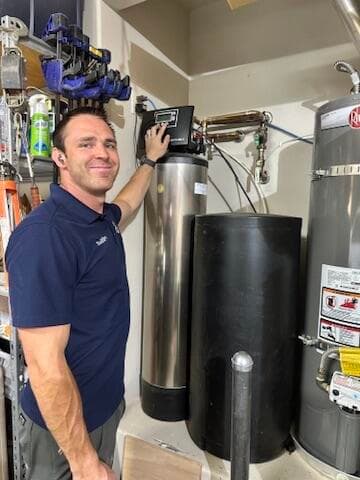
We install, maintain, and repair water softener systems for homes and businesses throughout Washington County. Installation includes tie-in to your supply line, drain connection, salt storage setup, and system programming. We also provide annual service to keep your softener running at peak performance.
- Extends appliance lifespan by years
- Eliminates scale buildup in pipes and fixtures
- Softer skin and hair
- Cleaner dishes and laundry
- Protects your water heater from scale
- Proper sizing for your household
Service Details
Quick Info
Timeline
1 day
Warranty
1-year labor + manufacturer
Know the Warning Signs
Signs You Need Water Softener Systems
Catching these early prevents a small issue from becoming a costly emergency.
Chalky white buildup on fixtures is a direct indicator of hard water. If it's visible on the outside, it's also inside your pipes and appliances.
Popping or rumbling from your water heater is almost always mineral sediment accumulated on the heating element — a direct result of hard water.
Spots and film on dishes despite using dishwasher detergent indicate hard water that no amount of detergent will fully overcome without softening.
Hard water minerals interfere with soap lathering and leave a film on skin that causes dryness. A softener noticeably improves skin feel.
Local Expertise
How St. George's Extreme Hard Water Affects Your Home
The Virgin River and Washington County's reservoir system deliver water that tests at 15–25 grains per gallon — that's classified as 'very hard' to 'extremely hard' by any industry standard. For context, most of the U.S. averages 3–7 GPG. When you turn on a faucet in St. George, you're running water through your pipes that carries 2–5 times the mineral content of a typical American city. That mineral load accumulates everywhere water touches: inside pipes, on heating elements, in valve cartridges, across every fixture surface.
The desert heat amplifies the problem. Hot water accelerates mineral precipitation, which is why water heaters are the first casualty of untreated hard water in Southern Utah. We routinely pull 2–3 inches of calcium sediment from the bottom of tank water heaters that have been running on unsoftened St. George water for just 4–5 years. That sediment insulates the heating element from the water it's supposed to heat, forcing the element to work harder, run hotter, and fail sooner. Tankless units are even more vulnerable because their narrow heat exchanger passages clog with scale faster.
New construction in areas like Little Valley, Desert Color, and the Bloomington Hills expansion are all connected to the same hard water supply. We strongly recommend installing a water softener during or immediately after construction — before hard water has a chance to start depositing scale inside new pipes and appliances. Retrofitting a softener later works fine, but the damage already done to your first water heater and fixtures during those unsoftened years can't be reversed.
Transparent from Start to Finish
How Our Service Works
Water Assessment
We test your water hardness and assess your household's water usage to recommend the right softener capacity.
System Selection
We help you choose from our range of high-efficiency softeners that match your home and budget.
Professional Installation
We install the softener, tie into your supply line, set up the drain, and program the regeneration cycle.
Walkthrough & Ongoing Support
We show you how to maintain your system and are available for annual service and salt checks.
Compare Your Options
Salt-Based vs. Salt-Free Water Treatment
Understanding the difference matters in St. George, where water hardness levels are 2–3 times the national average. Here's how the two approaches compare.
Our recommendation: For St. George's extreme hardness (15–25 GPG), we recommend salt-based softeners in nearly every case. Salt-free conditioners have a place in areas with moderate hardness, but they can't fully handle the mineral load in Southern Utah's water supply. We've installed both and are happy to discuss which approach fits your situation.
The Marlin Difference
Why Southern Utah Trusts Marlin
Local Hard Water Expertise
We deal with St. George's extreme hard water every day. We know exactly what capacity and type of system your home needs.
Proper Sizing
An undersized softener won't fully treat your water. We calculate your household's grain capacity requirement before recommending a system.
Complete Installation Service
We handle everything — supply connection, drain line, salt storage, and programming. No DIY required.
Ongoing Maintenance Available
We offer annual softener service to keep your system regenerating properly and extend its lifespan.
Related Services
Customers who needed this service also needed these.
Got Questions?
Water Softener Systems FAQ
Practical answers based on the questions St. George homeowners ask most.
Almost certainly yes. St. George's water hardness tests at 15–25 grains per gallon — well above the 7 GPG threshold where the Water Quality Association recommends softening. Without a softener, your water heater, dishwasher, faucets, and pipes will accumulate calcium scale that shortens their lifespan and reduces efficiency.
Water Softener Systems Across Southern Utah
Serving St. George and the surrounding Washington County communities since 1978.
Need Water Softener Systems?
Book online in a few clicks, or call for the current arrival window. Emergency calls are answered 24/7, with a clear estimate before work begins.
Family Owned & Operated • Since 1978 • Licensed & Insured • IAPMO Certified