
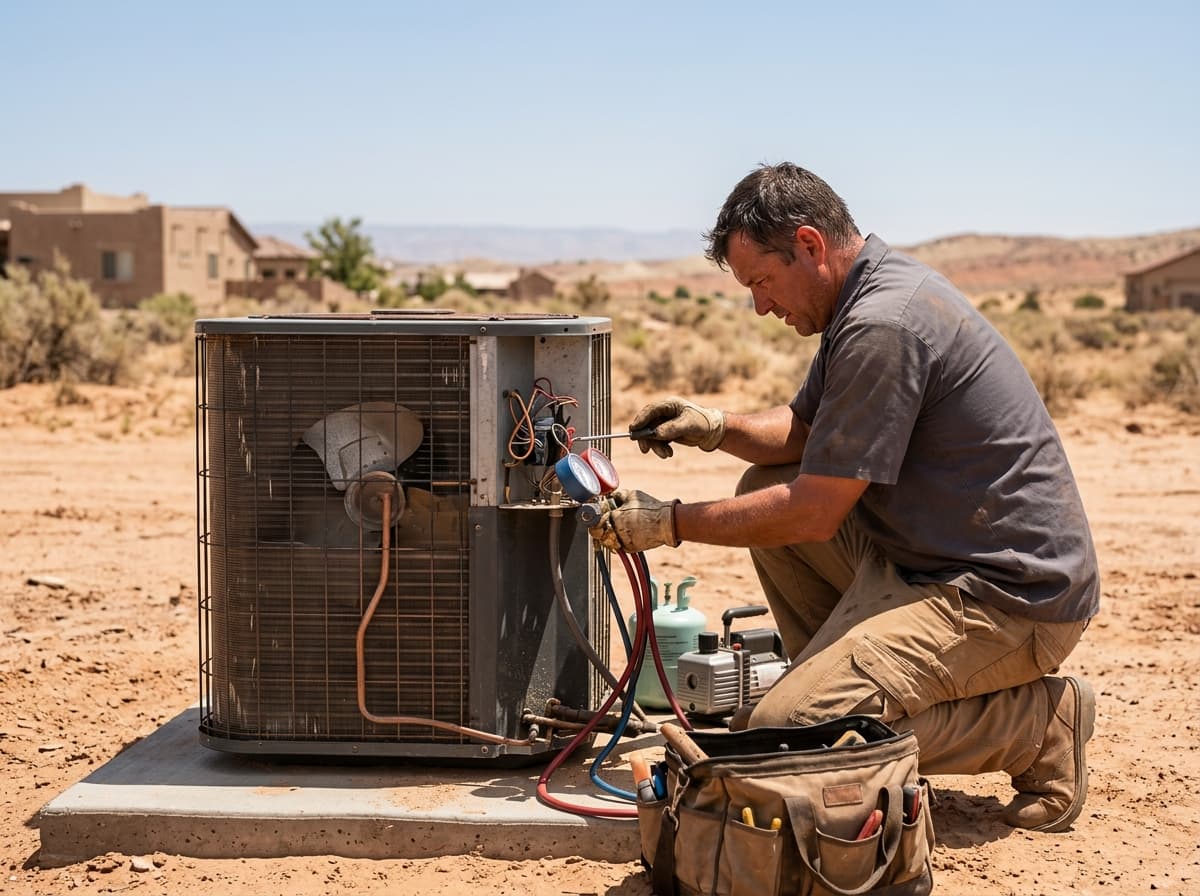
Ice on your air conditioner during the hottest month seems backwards, but it's a warning sign. Here's why it happens and the safe steps to take before you call.
It's the hottest week of the year in St. George, the thermostat is set to cool, and there's a sleeve of ice wrapped around the copper line at your outdoor unit. It looks like the system is working too well. It isn't. A frozen air conditioner is a system that's failing, and running it that way through an August afternoon is how a repair turns into a replacement. Here's what's actually happening, what you can safely do about it in the next hour, and when to stop and make the call.
How Your AC Is Supposed to Work
Inside your house there's a coil that gets cold. The blower pulls warm air from your rooms across that coil, the heat moves into the refrigerant, and the refrigerant carries it outside to be dumped by the unit in your side yard. As the coil chills the air, moisture condenses on it and drips into a drain pan. That's the whole cycle.
The coil stays cold but above freezing only as long as two things are true: enough warm air is moving across it, and enough refrigerant is in the loop. Take away either one and the coil drops below freezing. The moisture that should drip off freezes instead. Ice blocks more airflow, which makes the coil colder, which makes more ice. Once it starts, it feeds itself.
Cause One: Airflow Is Choked Off
This is the most common reason an AC freezes in Southern Utah, and it's the one you can usually fix yourself. A filter clogged with desert dust is the usual suspect. August is peak dust here, with monsoon winds loading the air and the system running nearly around the clock, so a filter that was fine in June can be packed solid by now.
It isn't only the filter. A return grille with a couch or a rug in front of it starves the system the same way. So do closed vents in unused rooms, which a lot of people shut thinking it saves energy. It doesn't, and it cuts airflow across the coil. A dirty indoor coil or a blower motor on its way out does the same thing from inside the cabinet, and those two are a technician's job to find.
Cause Two: Low Refrigerant
Refrigerant doesn't get used up. If your system is low, it leaked. With less refrigerant in the loop, the pressure in the indoor coil drops and the coil runs colder than it was designed to, cold enough to freeze the moisture on it even with perfect airflow.
The tell is a freeze that comes back after you've replaced the filter and opened every vent. You might also hear a faint hiss near the lines or notice the system running much longer than it used to for the same result. Refrigerant is not a homeowner item. It takes a licensed technician to find the leak, fix it, and recharge the system properly. Topping it off without finding the leak just buys a few weeks.
Cause Three: Running Flat Out in Extreme Heat
St. George afternoons in August push an air conditioner as hard as it will ever be pushed. The system may run from midday until well after dark without cycling off. A unit in good shape handles that. A unit with a slightly dirty coil, a blower that's lost some strength, and a filter that's a few weeks overdue was getting by in May and can't get by now.
That's why the freeze shows up in the worst week of the year rather than a mild one. Nothing new broke. The margin that was hiding a few small problems just ran out.
The Signs You're Looking At
The obvious one is ice or heavy frost on the larger, insulated copper line where it leaves the outdoor unit, or on the same line where it enters the indoor unit in the closet, attic, or garage.
The less obvious signs show up before the ice does. Airflow from the vents gets weak even with the fan running hard. The air coming out is cool at best, then room temperature, then outright warm. The system runs and runs without reaching the set temperature. And as the ice starts to thaw, water shows up on the floor around the indoor unit or drips from places that are normally dry. If you see water there and the unit has been running nonstop, assume a freeze until you know otherwise.
What to Do Right Now
Turn cooling off at the thermostat, and switch the mode to off rather than just raising the temperature. Then set the fan from auto to on. The blower will keep moving room air across the frozen coil and thaw it without running the compressor. Depending on how much ice built up, this can take a few hours. Put a towel or a shallow pan around the base of the indoor unit, because the meltwater has to go somewhere and the drain pan may not keep up.
While it thaws, pull the filter and hold it up to a light. If you can't see light through it, replace it. Walk the house and open every vent, then move anything blocking a return grille. Once the ice is completely gone and the filter is fresh, you can switch back to cool and watch it. If the line stays clear and the air comes out cold, you've probably found your problem. If frost creeps back within an hour or two, shut it off again and leave it off.
A few don'ts. Don't chip, scrape, or pour hot water on the ice; the coil fins are soft and the line is easy to damage. Don't open the unit's panels. Don't touch the refrigerant lines beyond looking at them. And don't run it frozen because it's hot and you're hoping it will push through.
Why Running It Frozen Risks the Compressor
The compressor in your outdoor unit is built to pump refrigerant vapor. When the indoor coil is iced over, the refrigerant can't pick up heat from the house air, so it heads back to the compressor as liquid instead of vapor. Liquid doesn't compress. The compressor strains against it, overheats, and takes on damage that doesn't heal. It's the heart of the system, and every hour a frozen system keeps running takes a little more out of it.
There's a second cost that's easier to miss. A big freeze means a big thaw, and the meltwater doesn't always find the drain pan. Water in a hallway closet, in an attic above a ceiling, or in a garage next to stored boxes does damage of its own. Shutting the system off early keeps both problems small.
When to Call Marlin
If the ice comes back after a fresh filter and open vents, if you hear hissing near the lines, if the air is warm no matter what you do, or if you found water where it shouldn't be, that's a call for AC repair. If it's the middle of an August night and the house is climbing past the point of comfort, that's a call for emergency AC repair, and it's exactly what we're set up for.
And if the filter is the thing that got you here, air filter replacement on a schedule that fits our dust is the simplest protection your system can have. Marlin Plumbing Heating and Air has been keeping St. George homes cool since 1978, and we've thawed more August air conditioners than we can count. Shut it off, run the fan, and reach out. We'll take it from there.

Marlin Plumbing Heating & Air
Serving St. George, Utah since 1978