
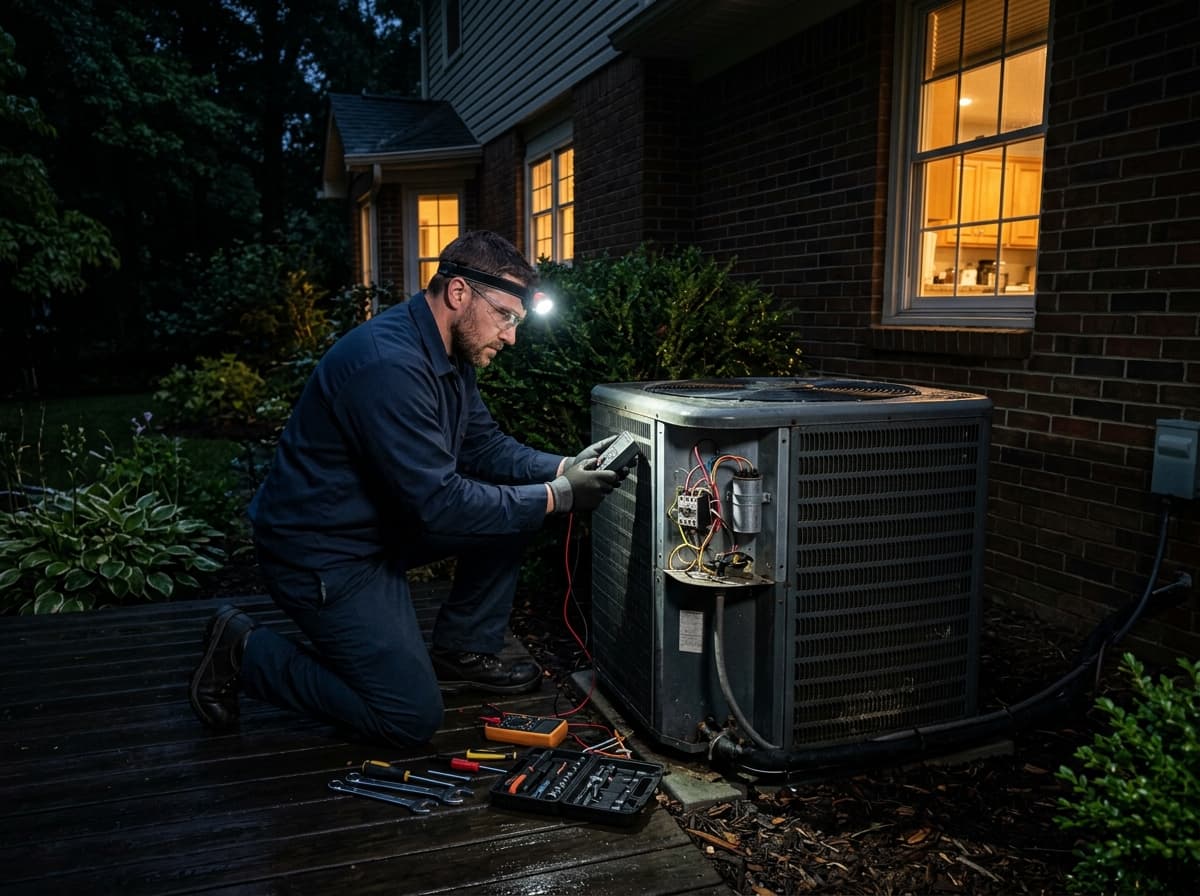
Southern Utah's late-summer storms pack dust into your AC, flicker the power, and send water where it shouldn't go. Here's what to look for once the sky clears.
Every August in St. George the afternoon sky goes dark over the Pine Valley Mountains, the wind comes up out of nowhere, and the rain hits harder in a few minutes than it did all spring. That's monsoon season in Southern Utah. The storms are short and loud and usually done before dinner, but they leave a mark on the two systems your house leans on hardest this time of year: the air conditioner sitting outside and the drains running underneath. Here's what those storms actually do to your plumbing and HVAC, what's worth checking once the sky clears, and what's better left to a technician.
Why a Desert Storm Is Harder on a House Than It Looks
Our ground spends most of the summer baked hard. When a monsoon cell drops a lot of water in a hurry, the soil can't take it in fast enough, so the water runs. It runs off roofs, across driveways, down the street, and toward whatever is lowest, which is sometimes your foundation, your garage floor drain, or the cleanout in the side yard.
The storm brings wind ahead of the rain and drags a wall of dust and debris with it. Then the power flickers as lines get knocked around. And within an hour of the rain stopping, the sun is back and the temperature is climbing again, which means your air conditioner has to go straight back to work whether or not it's ready. Every one of those things lands on your plumbing or your HVAC.
Dust and Debris Packed Into the Outdoor Unit
The outdoor half of your air conditioner is where the heat from inside your house gets dumped. It does that through the thin metal fins wrapped around the unit, and it only works if air can pull through them freely. A monsoon wind loads those fins with wet dust, shredded leaves, bits of tumbleweed, and whatever else was loose in the neighborhood. When the sun comes back out, the wet dust dries into a crust.
A unit that can't breathe runs hotter and longer, cools the house less, and puts real strain on the compressor, which is the part you least want to replace. After a storm, walk out and look at the unit. Pick up any branches, leaves, or trash piled around it and against it, and keep the area around it clear. If the fins themselves are caked in mud or bent flat, or if the unit sounds different than it did yesterday, leave it alone and have a technician clean it properly. Don't pull panels and don't spray into the unit.
Power Flickers, Surges, and the AC That Won't Restart
Lightning and wind do a number on the power grid, and your house feels it as flickers and short outages. Modern air conditioners are full of electronics, and they don't love being knocked off and on in quick succession. Sometimes the system just needs a clean restart: set the thermostat to off, wait several minutes, then set it back to cool. Look at your breaker panel too. If a breaker tripped, resetting it once is reasonable. If it trips again, stop. That's the system telling you something is wrong, not asking for another try.
If the outdoor unit hums but the fan doesn't spin, if it starts and stops every few minutes, if the thermostat screen is blank, or if it simply never comes back after the power does, a surge may have taken out a capacitor, a contactor, or a control board. Those are common storm casualties and they're repairable, but they aren't something to keep cycling from the thermostat hoping it fixes itself. Each attempt adds wear on a compressor that's already under stress.
Water Where It Shouldn't Be
This is the plumbing side of monsoon season, and it's the part people don't expect. Once the ground around your house is saturated, water looks for the easiest path, and sometimes that path is your drain system. A sewer line that was already a little slow, a floor drain in the garage or basement, a cleanout with a loose cap, all of them can gurgle, back up, or push water where it has no business being. Roof runoff dumped right at the foundation by a short downspout makes it worse.
Some homes in the area have a sump pump, though not many. If yours does, listen for it during and after the storm. It should cycle on, run, and shut off. A pump that runs constantly or never runs at all is worth a call. For everyone else, the things to note are simple: which drain acted up, how long after the rain it started, whether it cleared on its own, and whether there's a sewer smell. Don't reach for a chemical drain cleaner or a rented machine. Saturated ground and a stressed line are a job for someone with a camera and the right equipment.
Gas and Generators, Kept Simple
Two things worth saying plainly. First, if you smell gas after a storm, don't investigate. Leave the house and call your gas utility's emergency line from outside. Second, generators. If you have a standby generator installed, it should handle a flicker or an outage on its own. Follow the manual for your unit, know what its regular self-test sounds like, and note if it doesn't run when it should.
If you're using a portable generator to ride out an outage, never run it inside the house, in the garage, in a carport, or near an open window or door. Carbon monoxide is odorless and it builds fast. Keep it outdoors, well away from the house, and follow the manufacturer's instructions for placement and connection. That's the whole rule.
The After-the-Storm Walk-Around
Once the rain stops and it's safe to be outside, do a slow lap around the house. You're only looking and listening, not fixing. Start at the outdoor AC unit. Is it running? Is it loud or rattling? Is there debris piled against it or water standing around its base? Go inside and put your hand over a vent. Is the air moving, and is it cold?
Then check the low spots. Look at floor drains in the garage, laundry room, and basement if you have one. Look under sinks and around the water heater for anything wet. Run a sink for a minute and listen for gurgling from a nearby drain or toilet. Outside, follow each downspout and see where the water actually went. Pooling against the foundation is worth noting even if nothing else is wrong yet.
Finally, use your nose. Gas, sewer, and hot electrical each have a distinct smell, and any of them after a storm means stop and call. Take photos of anything that looks off, write down the time, and you'll give whoever shows up a head start.
When to Call Marlin
If your air conditioner won't restart after a power flicker, runs but doesn't cool, sounds wrong, or has fins packed with storm debris, that's a call for AC repair. If a drain backed up, a floor drain gurgled, or water showed up somewhere it never has before, that's a call for drain services, and it's better to have the line looked at now than during the next storm.
And if you're tired of holding your breath every time the lights blink, a Generac standby generator installation means the next outage doesn't touch your AC, your fridge, or your water heater. Marlin Plumbing Heating and Air has been a family-owned shop in St. George since 1978, and we've worked through a lot of monsoon seasons. Reach out and we'll get you sorted before the next cell rolls in.

Marlin Plumbing Heating & Air
Serving St. George, Utah since 1978