
Late-summer water bills in St. George run high anyway, which makes a hidden leak easy to miss. Here's the meter test and the other checks that catch one before it does real damage.
Late summer is when a St. George home uses the most water. The heat is at its worst, lawns and drip lines are running hard, and the bill reflects all of it. That's what makes it the easiest time of year to miss a leak. When the bill is high for good reasons, a little extra on top doesn't stand out, and a leak that starts in July can run into fall before anyone notices. If your bill jumped more than the heat explains, here's how to check.
The Meter Test You Can Do This Weekend
The most reliable check a homeowner can do needs no tools. Start by making sure nothing in the house is using water: no faucets, showers, washer, dishwasher, or ice maker running. Then turn the irrigation controller off and make sure nobody flushes a toilet for a while.
Now find your water meter. It's usually in a box at ground level near the street or sidewalk, under a lid that lifts off. Most meters have a small low-flow indicator on the face, a little triangle, star, or wheel that turns whenever any water passes through, even a trickle too small to move the main numbers. If everything is off and it's moving, water is going somewhere on your side of the meter. No indicator? Note the reading, leave everything off for a couple of hours, and check again; any change means a leak.
This test tells you that you have a leak, not where. The rest of this list narrows that down.
The Running Toilet: The Most Common Silent Leak
Start with the toilets. A running toilet is the most common hidden leak in any house, and it makes almost no noise. The flapper at the bottom of the tank wears out or gets stiff from hard water, and water seeps from the tank into the bowl around the clock. The fill valve tops the tank up a little at a time, so you never hear the big refill.
The food-coloring test finds it. Lift the tank lid, add a few drops of food coloring, and don't flush. Come back after a while. If the bowl water has taken on the color, that toilet is leaking. Run it on every toilet, because it's often the guest bathroom one nobody uses that's been running for months. A toilet that refills on its own, or needs the handle jiggled, is saying the same thing.
Irrigation and Drip Lines Underground
Southern Utah yards live on irrigation, and the lines are buried where you can't see them. A cracked lateral, a split fitting, or a drip emitter that blew off runs every time the zone comes on, and in summer that's daily. Because the ground is hot and dry, much of that water disappears before it shows on the surface.
Walk the yard while each zone runs. Look for a patch that's greener than the rest, ground that stays soggy after the rest has dried, a sunken spot, a puddle at a valve box, or water bubbling up where there's no head. Then repeat the meter test with irrigation on: if the indicator moves only when the sprinklers are live, the leak is in the yard. Drip tubing usually sits on the surface under mulch, so pull it aside and look. For anything buried, leave the shovel in the garage; guessing tears up a yard and usually misses.
Slab and Under-Floor Leaks
A lot of St. George homes sit on a concrete slab with the water lines underneath it. When one fails, the water goes into the ground under the house, and the signs are subtle. The classic one is a warm spot on the floor: a leaking hot water line heats the slab and the tile above it, and you'll feel it barefoot. Others: the sound of water running in a wall or floor when everything is off, flooring that's lifting or cracking, damp carpet or baseboard along an interior wall, a musty smell, or a wet stretch of foundation when the rest is dry.
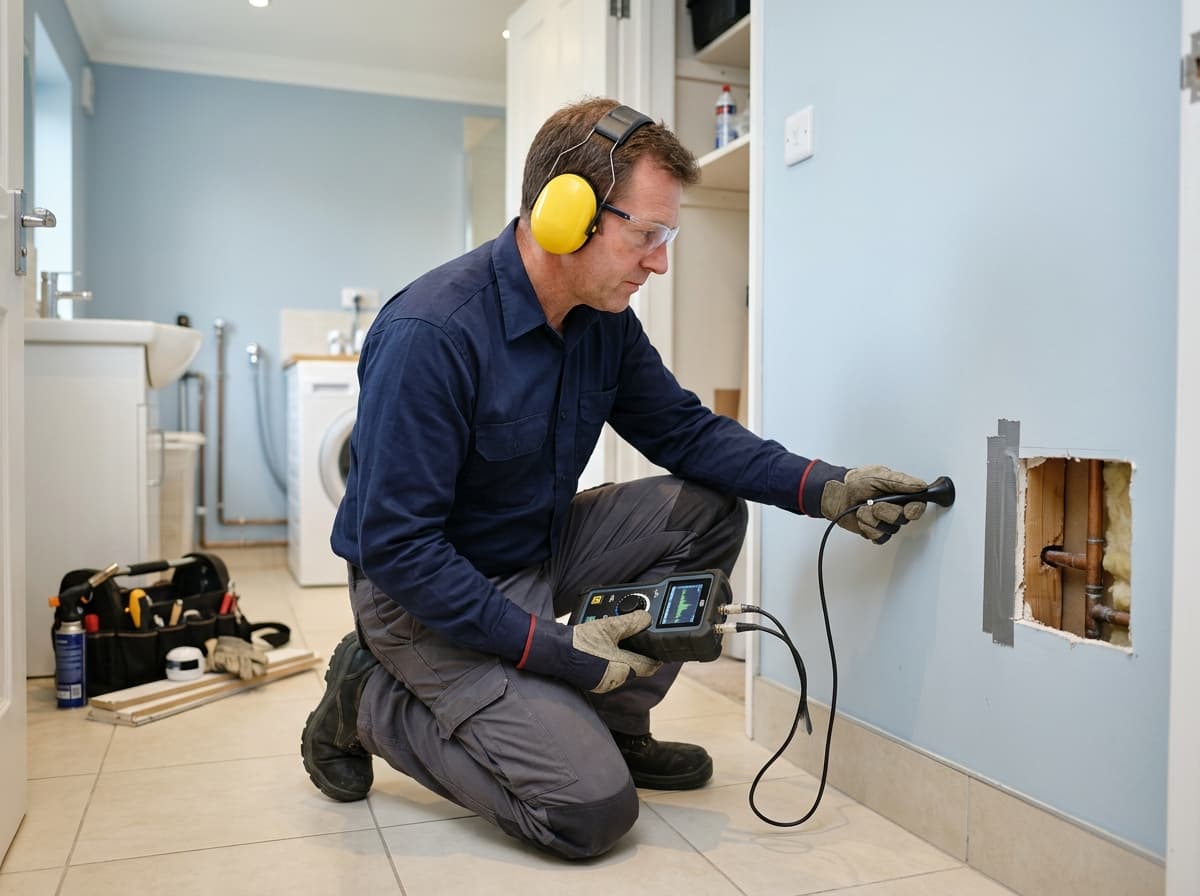
Homes with a crawl space show similar clues: damp spots that keep coming back, soft flooring. Don't try to chase a slab leak yourself. Pinpointing one takes listening equipment and pressure testing, and getting the location right is the difference between a small repair and tearing up a floor.
The Leaks Inside the House Nobody Checks
Some leaks hide in plain sight in the garage or utility room. A failing water heater often starts as a slow weep from the bottom of the tank or from the relief valve's drain line down the side of the unit. A damp ring on the concrete, rust streaks, or water in the drip pan are worth noticing. Water softeners have a drain line too, and one stuck mid-cycle can run water down the drain continuously without you ever seeing it.
Then open every sink cabinet. Supply lines and shutoff valves fail quietly: a braided line weeps at the fitting, a valve drips from the stem, a trap seeps at a slip joint. Look for water stains, swollen particleboard, or a musty smell. White chalky crust on a fitting is a reliable marker here; it's what our hard water leaves behind when it evaporates. Run a dry fingertip along the lines; it finds a damp spot a glance misses.
Your Side of the Meter or Theirs?
When a leak turns up, the first question is whose problem it is. As a general rule, the meter is the dividing line: the line from the street to the meter belongs to the water provider, and everything on the house side, including the service line from the meter to your foundation, is generally the homeowner's. Your provider can tell you exactly how they handle it.
If the meter test shows flow with everything off, the leak is on your side, because the meter only registers water that has passed through it. Wet ground between the street and the meter box, or a meter box full of water, is worth a call to the provider first. Wet ground between the meter and the house usually means a service line leak, which is on your side.
Why a Small Leak Matters More in the Desert
It's tempting to let a slow leak go. In a desert climate that's a mistake, and not just because of the bill. The soil around a foundation here is normally bone-dry, and the foundation was built for that. Keep a patch of it saturated for months and it can shift, settle, or heave, and the cracks show up in drywall, tile, and door frames. Moisture inside a sealed-up, air-conditioned house has nowhere to go, so a damp cabinet or wet wall cavity turns to mold faster than you'd expect.
Leaks also cost you pressure: water takes the open path, so fixtures at the far end of the house run weaker while it's flowing. And because hard water leaves scale wherever it dries, a leak that's been evaporating for months leaves mineral damage behind. Fixing it early keeps a small plumbing repair from turning into a foundation, flooring, or mold job.
When to Call Marlin
If the meter keeps moving with everything off and you can't find where the water is going, stop guessing. Marlin handles leak detection with the equipment that pinpoints a leak under a slab or in a yard without tearing things up, water main repair for the service line between the meter and your house, and toilet repair for the running toilet so often behind the mystery.
We've been finding and fixing leaks in St. George and across Southern Utah since 1978, and late summer is when a lot of them surface. Give us a call, tell us what your meter is doing, and we'll take it from there.

Marlin Plumbing Heating & Air
Serving St. George, Utah since 1978