
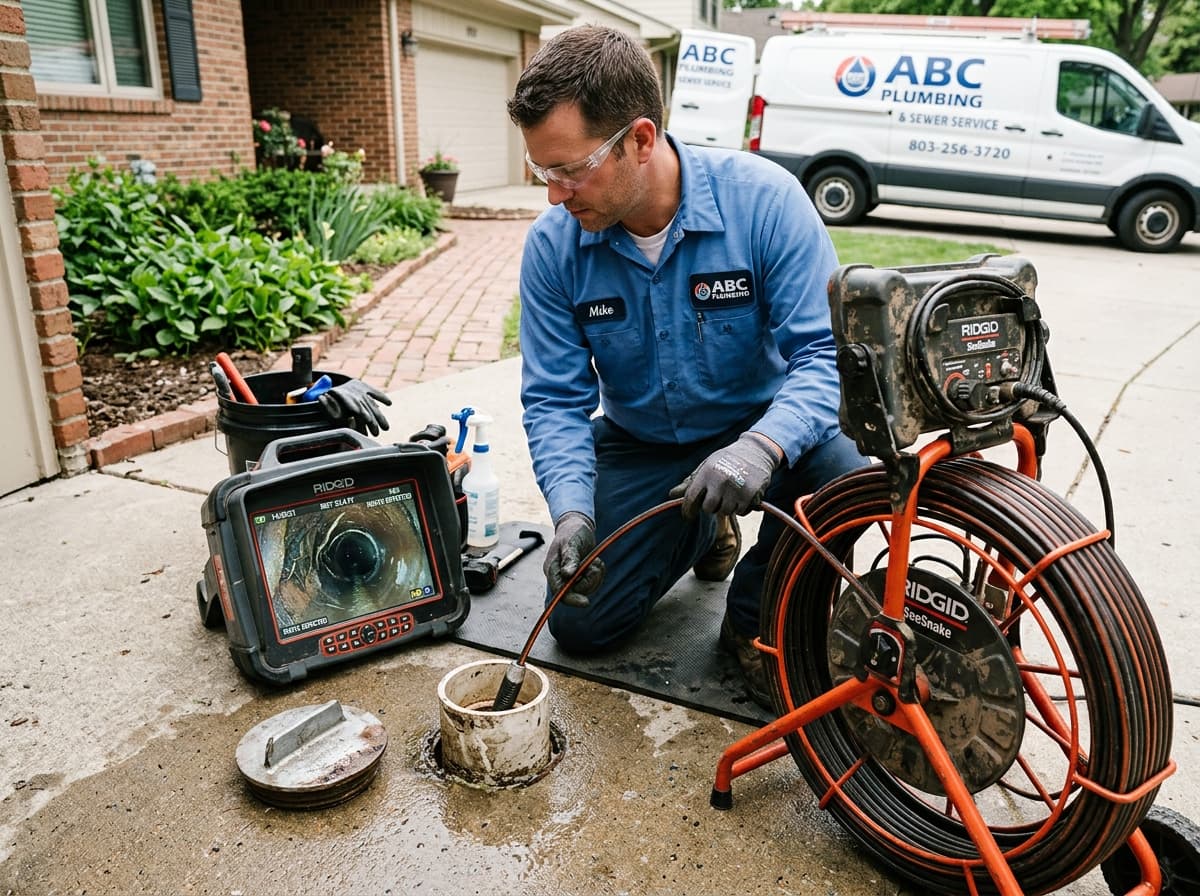
A sewer camera inspection replaces guessing with a look inside the line. Here's when it pays off in St. George homes, what it commonly finds, and what happens next.
Every homeowner in St. George has had the same conversation with a slow drain: it backs up, somebody clears it, and everyone hopes that's the end of it. Sometimes it is. Sometimes the same line backs up again a few months later, and now you're guessing — roots, grease, or a pipe that's actually failing? A sewer line is buried under your yard or your slab, and for a long time the only way to know what was happening down there was to dig. A sewer camera inspection replaces that guessing with a look. Here's what it is, when it's genuinely worth doing, and what it tends to show in Southern Utah homes.
What a Sewer Camera Inspection Actually Is
The equipment is simpler than it sounds. A technician feeds a small waterproof camera on a flexible cable into your sewer line, usually through the cleanout — the capped access point outside the house or in the garage. The camera carries its own light, and the feed shows up live on a monitor above ground, so the technician sees the inside of the pipe as the camera travels through it.
The camera head also carries a small transmitter. As it moves, the technician can follow it from the surface with a handheld locator, so when the camera stops at a problem, they can walk out into the yard and mark the exact spot and roughly how deep it sits. That detail is the difference between one small hole in the right place and tearing up half the lawn hunting for a break.
When It Pays to Look
Not every drain problem needs a camera, but a handful of situations earn it every single time.
Buying a home is the big one, especially an older home in one of St. George's established neighborhoods. A standard home inspection covers the house, but the sewer line running out to the street usually isn't part of it. Older lines are often clay or cast iron, and a line that seems fine from the fixtures can be cracked, sagging, or half full of roots. A camera inspection before you close tells you what you're buying and gives you real footage to negotiate with if something turns up.
Recurring backups or slow drains that come back after being cleared are the next most common reason. If a line has been snaked more than once and keeps slowing down, something is catching debris — roots, a sag, an offset joint. Clearing it again treats the symptom. The camera shows the cause.
Mature trees near the line are their own warning sign. Roots follow water, and a sewer line with even a hairline gap at a joint is exactly what they're looking for. In an older neighborhood with big established landscaping, a look before roots become a full blockage is just smart.
A few other cases: a home that has never had the line looked at. A remodel that adds a bathroom, since you'll be putting more load on a pipe you've never seen. And after any major backup, to confirm the cause before assuming it was a one-time thing.
What the Camera Commonly Finds
In Southern Utah homes, a few things show up again and again.
Root intrusion tops the list. Roots enter at joints and cracks, then grow into a mat that catches everything passing through. On the monitor it looks like a web across the pipe — sometimes a thin fringe, sometimes a near-total block.
Bellies, or sags, are low spots where the pipe has settled and water sits instead of draining. You can see it on screen: the camera goes underwater for a stretch, then comes back out. Standing water in a belly collects sediment and grease, so the same spot keeps clogging.
Offset or separated joints are common in older clay and cast-iron lines. Ground movement, roots, or plain age pull sections apart so they no longer line up. The camera shows a ledge or a gap where debris snags, and in bad cases you can see soil coming through.
Beyond those: grease build-up narrowing the pipe from the inside, scale and corrosion roughening old cast iron, and crushed sections where the pipe has been flattened by weight above it or a shifting foundation.
A Clog or a Break? The Camera Settles It
This is the single most useful distinction a camera makes. A clog and a break can produce the same symptoms upstairs — slow drains, gurgling, water backing up in a tub or floor drain — but they call for completely different fixes.
A clog is an obstruction in an otherwise sound pipe. Clear it and the pipe goes back to working. A break, whether a crack, a separated joint, or a crushed section, is a pipe problem. Clearing whatever's caught on it buys a little time, but it'll catch again, and meanwhile wastewater may be leaking into the soil around your foundation.
Without a camera, the evidence is how the drain behaves and what the technician feels on the cable. With a camera, you see it. Nobody guesses, and you don't pay for a repair you didn't need or skip one you did.
What Happens After the Inspection
The inspection itself doesn't fix anything. What it does is tell you which of three paths you're on.
If the camera shows a sound pipe with a build-up problem — grease, roots that haven't damaged the line, sediment in a shallow belly — the answer is cleaning. Hydro jetting scours the full inside of the pipe wall with high-pressure water, and a follow-up camera pass confirms it's clear.
If the camera finds one damaged section in an otherwise good line, a spot repair replaces just that section. Because the technician marked the location and depth from above, the excavation is small and goes exactly where it needs to.
If the line is failing in several places, badly corroded, or made of material at the end of its life, the honest answer is replacement. That's a bigger job, but you make the decision with footage in front of you instead of on a hunch.
Why It's Cheaper to Know Than to Guess
Guessing gets expensive in one of two ways. Either you keep paying to clear a line with a structural problem, or you pay for a repair based on symptoms that turns out to be the wrong fix. Both happen more often than they should.
A camera inspection takes the guess out. You know whether the pipe is sound. You know where the problem sits and how deep. You know whether you're looking at a cleaning, a small dig, or a replacement — and you know before anyone picks up a shovel. For a home you're about to buy, or a line that has failed more than once, that certainty is worth far more than the look.
Plenty of St. George homeowners have a camera run simply to confirm the line is fine. If it is, you have footage that says so and a baseline for later.
When to Call Marlin
If you're buying a home, fighting a drain that keeps backing up, or just tired of not knowing what's happening under your yard, a sewer camera inspection is the place to start. We run the camera, mark what we find from above, walk you through the footage, and give you a straight answer. From there we handle whatever the line needs — hydro jetting to clear it, a spot repair, or full sewer line repair and replacement.
Marlin has been looking after plumbing in St. George and across Southern Utah since 1978, and we know what our soil, our trees, and our older neighborhoods do to a sewer line. Give us a call and let's find out exactly what's going on down there.

Marlin Plumbing Heating & Air
Serving St. George, Utah since 1978