
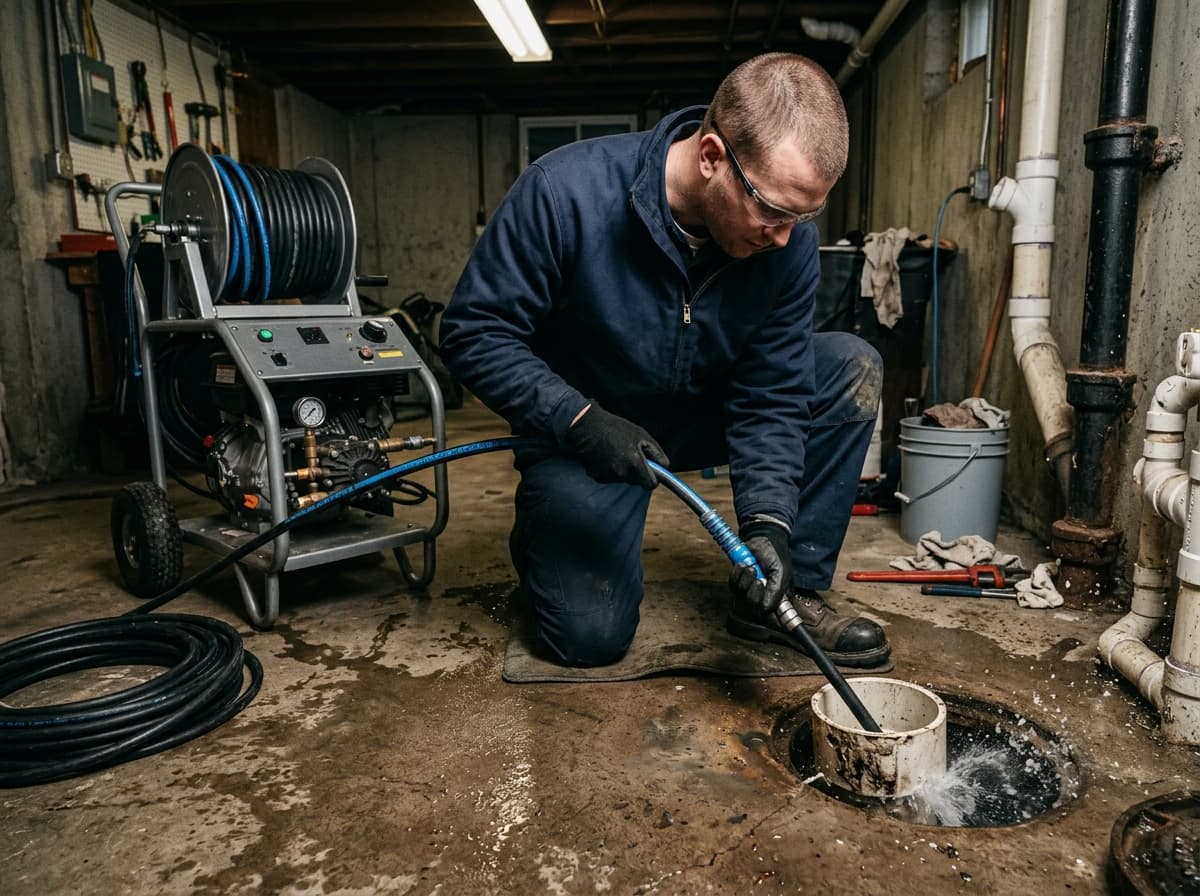
Snaking opens a hole through a clog; hydro jetting cleans the whole pipe wall. Here's how to tell which one your slow drain needs before the holiday crowd arrives.
September in St. George is when the calendar starts filling up. Thanksgiving is a couple of months out, the holidays follow right behind, and for a lot of families that means a house full of guests, a kitchen running all day, and every shower in use by morning. It's also the month a slow drain stops being a nuisance and becomes a problem waiting for the worst possible weekend. If your kitchen sink drains like it's thinking about it, or the shower backs up around your ankles, now is the time to fix it for good — not clear it one more time and hope. That starts with understanding the two ways a plumber actually cleans a drain, and which one your line needs.
How Snaking Works (and What It's Good For)
Snaking, also called cabling, is the method most people picture. A long flexible steel cable with a cutting or corkscrew head is fed into the drain and spun by a motor. When the head reaches the clog, it either bores a hole through it or grabs hold so it can be pulled back out.
It's fast and direct, and for the right job it's exactly what you want. A wad of hair in a bathroom drain, a toy in the toilet, a single obstruction in an otherwise clean line — a snake punches through, the water moves, and you're done. It's also the gentler option on the pipe itself, which matters when the line is old or its condition is unknown.
If you've got one drain that clogged once, snaking is very likely the answer. There's no reason to bring in heavier equipment for a problem a cable solves in one pass.
Where a Snake Falls Short
The limit of a snake is built into how it works. It clears a path. It doesn't clean the pipe.
Picture a kitchen line coated on the inside with years of grease, soap scum, and food residue. The opening in the middle narrows until something finally catches and the sink stops draining. The snake goes in, bores a hole through the plug, and the water flows. But the coating on the walls is still there. The pipe is still narrower than it should be, and the next bit of grease has the same rough surface to cling to. Weeks or months later, it's slow again.
That's the pattern behind the clog that keeps coming back. The snaking wasn't done wrong. A cable is built to open a hole, not to strip a pipe wall, so the underlying build-up never leaves. The same goes for roots: a cutting head chops through the mass, but the roots that came in at the joint are still there and will regrow.
How Hydro Jetting Works
Hydro jetting takes the opposite approach. Instead of a cable, a hose with a specialized nozzle is fed into the line and water is pushed through it at very high pressure. The nozzle sprays forward to break up whatever's ahead and backward at an angle, which pulls the hose deeper into the line and scours the entire inside surface of the pipe as it goes.
The result isn't a hole through the clog. It's a pipe wall cleaned back to bare material. Grease, scale, sludge, and root fibers are cut loose and flushed out toward the main. When the technician is finished, the line's full diameter is restored, which is why a jetted drain tends to stay clear much longer than one that's only been snaked.
It's a professional-only tool. Pressure that cuts through roots and hardened scale will also damage a pipe that can't take it, and knowing the difference is the technician's job. That's why jetting is so often paired with a camera.
When Jetting Is the Right Call
Recurring clogs are the clearest case. If the same drain has been cleared more than once and keeps slowing down, cleaning the pipe instead of just opening it is the approach that deals with the cause.
Grease-heavy kitchen lines are next. Kitchen drains build up faster than any other line in the house, and the holiday season piles on — turkey drippings, gravy, butter, everything that goes down the sink after a big meal. Jetting before that traffic arrives means the line starts the season clean.
Roots are a jetting job, provided the pipe is sound. High-pressure water cuts root intrusion out cleanly instead of leaving frayed stubs behind to regrow.
Restaurant and commercial lines are almost always jetting candidates. The grease and debris moving through a commercial kitchen drain is on another level, and routine jetting keeps it from becoming an emergency in the middle of a rush.
And jetting is the right prep before a camera inspection or a repair. A camera can't see the pipe wall through a layer of grease, and nobody can judge a crack or joint hidden under sludge. Jet first, then look, then decide.
When Jetting Is Not the Answer
Jetting is hard on a pipe that's already hurt. If a line has a crack, a separated joint, a collapsed section, or old cast iron corroded thin, high-pressure water can turn a problem into a bigger one — pushing through a weak wall, widening a gap, or washing out the soil behind a break.
That's the reason a camera inspection often comes first. A quick look inside tells the technician whether the pipe can handle jetting, or whether what you actually have is a repair job dressed up as a clog. Skipping that step is how people end up with an excavation they didn't plan for.
The other case is the simple one: a single clog in a single fixture. If a snake will do it, there's no reason to escalate.
What You Can Safely Do in the Meantime
While you're waiting for an appointment, there's a short list of things that genuinely help — and one thing that genuinely hurts.
Stop pouring grease down the sink. Let it cool and scrape it into the trash. It's the single biggest thing a homeowner can do for a kitchen line, and it matters most in the weeks around the holidays.
Use strainers in every drain. A simple mesh strainer in the kitchen sink and the shower catches food scraps and hair before they ever enter the line. It's the easiest maintenance there is.
Skip the chemical drain cleaners entirely. They work by generating heat and reacting with whatever they touch, and that includes your pipes. In older metal lines they speed up corrosion, in plastic lines they can soften joints, and in a drain that's fully clogged they often never reach the blockage — they just sit in the pipe. That last part is the real danger. The next person to open that line is a technician, and a drain holding caustic chemical can splash or off-gas onto whoever is working on it. If anything has been poured down a drain, tell your plumber before they start so they can handle it safely.
When to Call Marlin
If a drain in your home has been cleared before and it's slow again, or you'd rather head into the holidays knowing your kitchen line is clean than hoping it is, we can help you figure out which method the line actually needs. Our drain services cover both — snaking for the single clog, hydro jetting for the build-up that keeps coming back — along with a sewer camera inspection to make sure the pipe is sound before anything goes in it.
Marlin has been keeping St. George and Southern Utah drains moving since 1978. Give us a call before the guests arrive, and the only thing backing up this season will be the driveway.

Marlin Plumbing Heating & Air
Serving St. George, Utah since 1978